
Business-Level Services
in Detail
What These Services Deliver
Our business-level services help organisations achieve:
- Greater clarity around mission, vision and strategic priorities
- Stronger alignment between purpose, business strategy and brand
- A shared direction capable of mobilising leadership and teams
- Better decisions about what to preserve, develop or leave behind
-
Clearer objectives for growth, transformation and positive impact
- Stronger consistency between strategic ambition and organisational action
- Improved resilience and capacity to respond to change
- More credible differentiation rooted in real business capabilities
- A stronger strategic platform for branding, innovation and activation
When Company Purpose Becomes Business Direction
Business strategy sits between the enduring foundations of the company and the brand through which that strategy becomes visible and meaningful.
Above it are the company’s purpose, values, principles and distinctive idea. These provide continuity and define what the organisation should protect. At business level, those foundations are translated into mission, vision, strategic objectives, priorities, capabilities and models for creating value. Below, brand strategy turns them into positioning, promises, experiences and expressions that stakeholders can recognise and choose.
When these levels are disconnected, purpose becomes rhetoric, business strategy becomes tactical and branding is left to compensate through communication. Alignment creates the opposite effect: the company knows what it stands for, the business knows what it is trying to achieve and the brand gives people a credible reason to engage.
Mission, Vision and Strategic Objectives
Mission, vision and objectives are not ceremonial statements. Together, they create productive tension between present reality and future ambition.
The mission defines the contribution the business makes now and the role it chooses to play. The vision describes the future it intends to help build and the position it aspires to occupy. Strategic objectives translate that ambition into priorities and outcomes related to growth, transformation, performance and impact.
We help leadership teams make these definitions clear, ambitious and usable. They must stretch the organisation without detaching it from reality. When properly articulated, they align decisions, investment and behaviour, allowing different functions to move towards the same destination with greater consistency.
From Purpose to Promise: The Pokéball Model
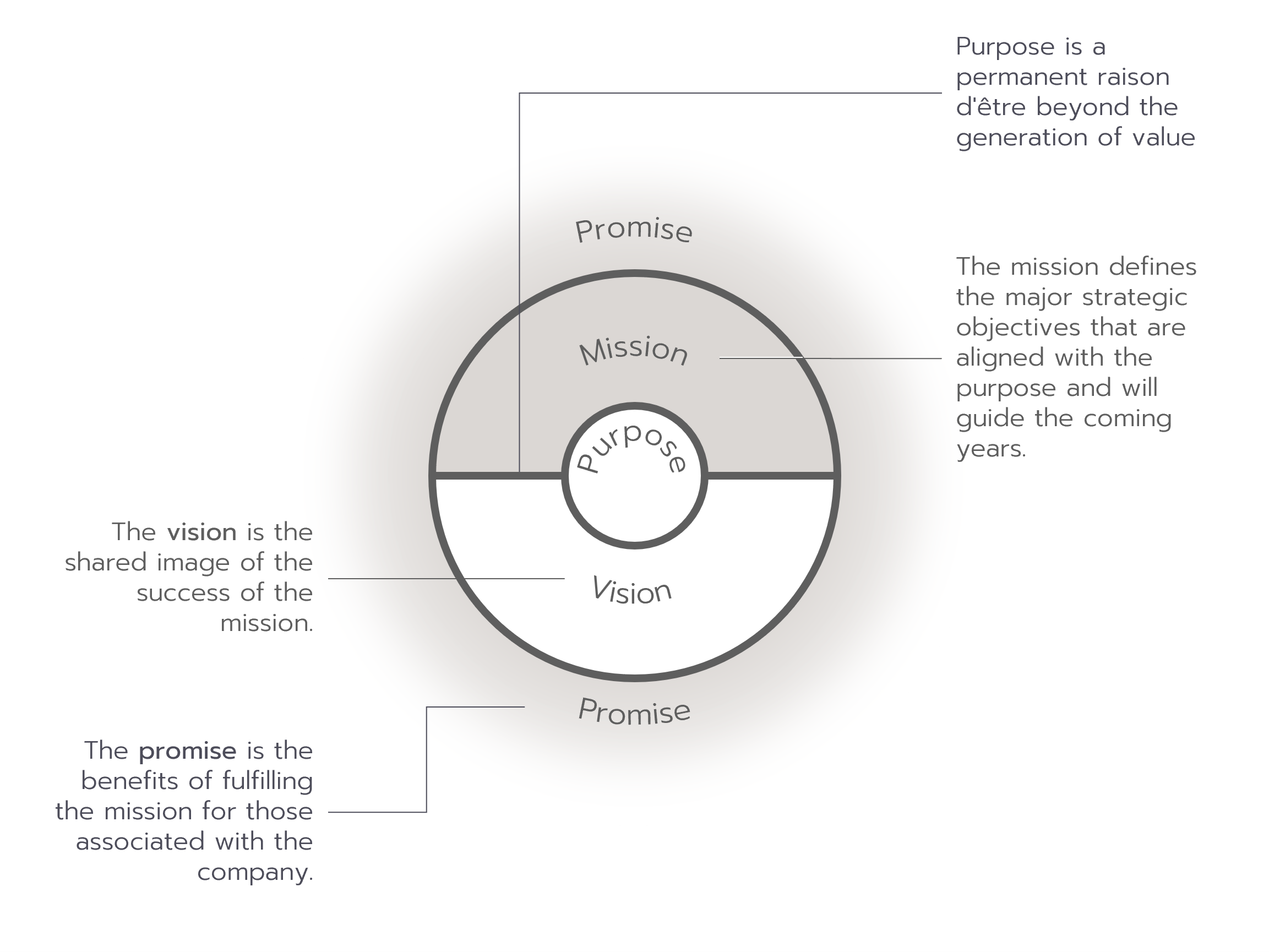
Our Pokéball model provides a simple way of visualising the relationship between company, business and brand.
The sphere represents the organisation as an interconnected system. Inside it, purpose, values, mission, vision, strategic objectives and capabilities contribute to its ability to learn, evolve and transform. Around it, the brand promise makes that internal logic visible to customers, employees, partners and other stakeholders.
The model helps leadership teams avoid treating strategic concepts as isolated statements. It connects what the company believes, what the business aims to achieve and what the brand promises. It also reminds us that strategy has no convenient corners in which contradictions can remain hidden.
Ambidextrous Strategy: Preserving and Developing Together
Business leaders often face a false choice: protect the core or pursue change. Our Ambidextrous Strategy approach treats continuity and transformation as simultaneous responsibilities.
We help clients identify what should be preserved -such as principles, knowledge, distinctive capabilities, sources of trust and profitable activities- and what needs to be developed, including new offers, technologies, experiences, markets and business models.
Ambidexterity is not a one-off destination. It is a management practice supported by clear structures, criteria and decision rules. It creates productive tension between legacy and aspiration, efficiency and innovation, present performance and future relevance. That tension can mobilise an organisation when it is governed well; ignored, it usually becomes inertia on one side or indiscriminate change on the other.
Businesses and Leaders on a Journey Towards Conscience
Business strategy also determines what kind of value the organisation is willing to create and at whose expense.
We support businesses and leaders on their journey towards greater conscience: considering the effects of strategic choices on customers, employees, partners, society, the environment and the organisation’s long-term viability.
Conscience is not an additional ethical statement placed beside the strategy. It is a decision-making framework. It helps leaders establish priorities, recognise limits, navigate trade-offs and ask whether growth is creating legitimate and sustainable value.
A conscious leader is not someone who avoids tension. It is someone prepared to govern tensions openly: between short- and long-term interests, performance and responsibility, different stakeholder expectations, and what is commercially possible versus what the organisation believes is right.
Coherence Between Business Strategy and Branding
Brand strategy is fundamentally a business matter. A brand cannot remain credible if its promise, positioning and experience are disconnected from the strategic direction and operational capacity of the business.
We therefore align business and brand strategy from the outset. Strategic objectives inform the brand promise; business priorities shape the customer proposition; distinctive capabilities provide credible differentiation; and the brand helps mobilise people around the strategy.
This creates consistency between what the organisation intends, what it does and what stakeholders experience. The brand becomes more than an expression of strategy: it becomes a shared operating system that helps the business make decisions and sustain direction during transformation.