Recyecology
Turning Sustainable Surfaces into a Global Community Conversation

- Brand: Recyecology
- Geographic Scope: Global
- Sector: Sustainable architecture, design, surfaces, circular economy, digital communities and stakeholder engagement

The Challenge
The challenge was to build relevance for ECO without reducing the conversation to product promotion or weakening the role of Cosentino’s established brands.
Our Approach
The platform allowed Cosentino to listen, learn and engage with people interested in the wider contexts in which its products were specified, used and valued.
The Impact
The platform helped position ECO by Cosentino while strengthening Cosentino’s visibility within sustainability conversations linked to architecture, design and lifestyle.
Our Relationship
Our role went beyond creating a campaign. We designed, launched and managed a platform where the brand could participate credibly in conversations that mattered to its audiences.
On This Page
The Challenges
Company
Cosentino wanted to demonstrate how it thought and behaved in relation to sustainability.
As a global company in architectural surfaces, it needed to show that environmental responsibility was not only a product attribute, but part of a wider way of understanding innovation, design and business.
It had to:
- Make its sustainability commitment more visible
- Support the launch of ECO by Cosentino
- Engage architects, designers and conscious consumers
- Listen directly to relevant audiences
- Build credibility beyond product advertising
- Connect innovation with responsible behaviour
Business
ECO needed to enter the market as a meaningful sustainable surface without competing against or cannibalising Cosentino’s existing products.
The business needed to:
- Position ECO in a new category
- Explain its sustainable value more clearly
- Reach audiences interested in architecture and design
- Create dialogue with customers, consumers and opinion leaders
- Understand the issues shaping specification and purchase decisions
- Build a platform for long-term stakeholder engagement
Brand
The brand challenge was to move from product communication to a broader sustainability conversation.
Recyecology had to give Cosentino permission to speak about subjects surrounding its products, not only about the products themselves.
The brand needed to balance:
- Product innovation and social relevance
- Sustainability and design appeal
- Corporate credibility and community dialogue
- Environmental responsibility and commercial value
- Cosentino’s authority and audience participation
Our Approach
Company and Business
We began by identifying the broader themes in which Cosentino’s products lived: architecture, design, innovation, interiors, cuisine, lifestyle and environmental responsibility.
The objective was to create a platform that could connect ECO with these conversations while also helping Cosentino understand its audiences more directly.
The work explored:
- Sustainability and architecture trends
- Audience needs and motivations
- Product-positioning opportunities
- Stakeholder engagement
- Digital community behaviour
- Content territories
- Dialogue and participation mechanics
- Opinion-leader relevance
- Commercial and reputational opportunities
This created the basis for a community rather than a one-off launch campaign.
Branding
We positioned Recyecology as a digital meeting point for people interested in more responsible ways of designing, building and living.
The platform connected Cosentino’s sustainable product innovation with broader cultural and professional questions.
The brand needed to be:
- Open
- Curious
- Informed
- Practical
- Design-conscious
- Responsible
- Participative
- Credible
Its voice had to speak about sustainability without becoming preachy, and about design without becoming superficial.
Support
On building a community brand around responsible design our work included:
- Community concept
- Platform positioning
- Digital ecosystem definition
- Stakeholder and audience mapping
- Content strategy
- Editorial planning
- Sustainable architecture content
- Innovation and design themes
- Cuisine and lifestyle content
- Customer and consumer dialogue
- Opinion-leader engagement
- Community management
- Ongoing content production
- Monitoring and learning
- Strategic support for ECO positioning
Activation and Hands-On Management
Community and Participation Journeys
We mapped how different audiences could engage with Recyecology.
These included:
- Architects
- Designers
- Specifiers
- Customers
- End consumers
- Sustainability professionals
- Opinion leaders
- People interested in responsible living
The platform gave each audience a reason to discover, read, comment, share, learn and participate in conversations beyond the product catalogue.
Digital Ecosystem
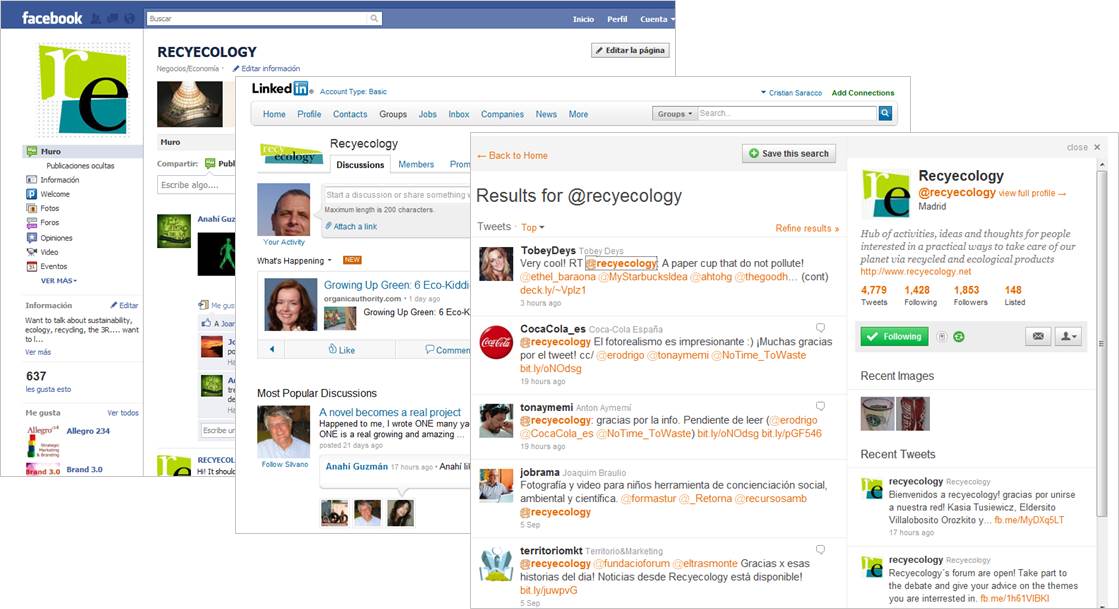
Recyecology worked as a corporate social network where Cosentino could host and participate in sustainability-related dialogue.
The ecosystem brought together:
- Sustainable architecture
- Design and interiors
- Innovation
- Cuisine and lifestyle
- Environmental responsibility
- Product context
- User participation
- Community interaction
This helped Cosentino connect product innovation with the cultural and practical questions shaping its audiences’ decisions.
Marketing and Communication
We developed and managed a communication framework covering:
- Community positioning
- Content themes
- Editorial rhythm
- Social participation
- Stakeholder engagement
- Opinion-leader dialogue
- Product-context communication
- Monitoring and feedback
The objective was to build relevance through useful participation, not through louder product claims.
Content Development
Content was the engine of Recyecology.
We created and managed material across themes including:
- Sustainable architecture
- Responsible design
- Environmental innovation
- Circularity and materials
- Interior spaces
- Cuisine and lifestyle
- Product-related context
- Community conversations
The content gave Cosentino a way to demonstrate what it believed, how it behaved and why ECO mattered within a larger movement.
Hands-On Implementation
Allegro 234 did not only define the strategy.
We managed the platform during its active period, supporting:
- Content production
- Community management
- Audience engagement
- Stakeholder dialogue
- Editorial planning
- Monitoring
- Learning and optimisation
- Alignment with ECO’s positioning
The result was a live relationship platform rather than a campaign pretending to be a community.
Transformation and Growth
+
+
+
Cosentino’s facilities also run on 100% renewable electricity, and its materials incorporate recycled minerals and more sustainable production technologies.
The Impact
Company
The project helped Cosentino make its sustainability thinking and behaviour more visible.
It provided:
- A platform for direct stakeholder dialogue
- A credible environment for sustainability conversations
- Greater understanding of audience interests
- A way to connect product innovation with responsible behaviour
- A broader context for ECO by Cosentino
- Early experience in digital community management
Recyecology helped Cosentino participate in conversations beyond surfaces and specifications.
Business
The work supported the market introduction and positioning of ECO by Cosentino.
It created:
- A differentiated context for ECO
- Dialogue with customers, consumers and opinion leaders
- A platform for listening and learning
- A way to avoid cannibalising other Cosentino products
- Stronger links between sustainability interest and product relevance
- International visibility in architecture and design-related conversations
The project turned a product launch into a wider stakeholder-engagement opportunity.
Brand
Recyecology gave Cosentino a more participative sustainability voice.
This included:
- A community identity linked to responsible design
- Content territories around architecture, innovation and lifestyle
- A more credible way to discuss sustainability
- Stronger association between Cosentino and environmental innovation
- A platform that made beliefs and behaviour visible
- A bridge between ECO and wider cultural conversations
The brand could speak about sustainable surfaces without reducing sustainability to a sales argument.


"I work with Allegro 234 already for two years and I am happy to continue the journey together! The main reason is that I feel comfortable to hand over the overall branding, marketing and project management activities to this professional team."
Adam Dubielecki, Founder